Trump will guarantee Alberta’s secession (if Albertans vote for it)
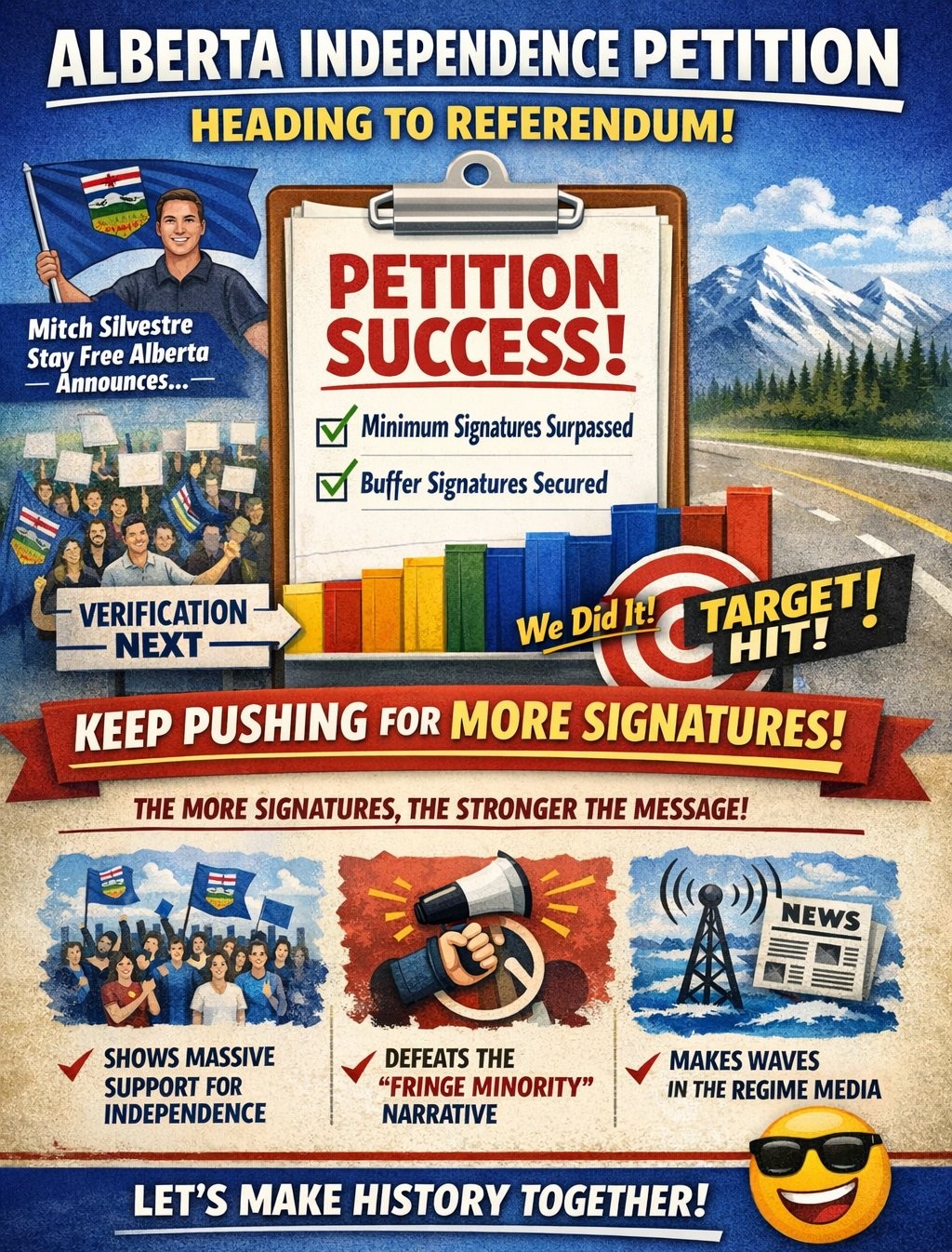
The petition campaign to get Alberta independence on Alberta’s ballot has surpassed the minimum number of signatures required for it to proceed to a referendum. Plus, there’s already enough buffer signatures to make up for any which will be disqualified by Elections Alberta during their review & verification, according to Mitch Silvestre, leader of the campaign. Legally, the campaign is organized by a new shell organization for the petition called Stay Free Alberta, but is indirectly supported by Alberta Prosperity Project, where the money & personnel are.
The push for as many more signatures as possible continues, to demonstrate that there’s momentum on the side of independence.
But will it actually be on the ballot?
One low-level judge in 2025 stopped the previous petition because he was afraid it would infringe on the treaty rights of indigenous tribes with the “Crown.” Lawyers who support independence say treaty rights would not be infringed because international law of succession obligates successor states of dividing countries to abide by their mother country’s treaty. There will be an April 7, 2026 hearing on the new petition, but it is not known who the judge will be, or how higher courts will rule.
Would Canada let Alberta go?
If Alberta votes for independence October 19, 2026, the federal government is obligated to negotiate with Alberta, according to the Clarity Act and Supreme Court rulings. If Alberta chooses to follow Canadian law, secession could be blocked by a failure to ratify a constitutional amendment to legalize the outcome of those negotiations, according to Grok. In this case, such an amendment would require consent by Parliament and 7 provinces, according to Grok. It’s unlikely an amendment would be ratified, because Alberta provides huge subsidies for most Canadian provinces, especially Quebec. Quebec is likely to secede, if it doesn’t get those subsidies. Since Canada is organized as a row of provinces, a single secession of a middle province makes the country noncontiguous. And British Columbia is a leftist province uninterested in secession, because bulk of the population are the leftists along the southern edge of the province.
But Trump can ensure Alberta & Saskatchewan’s secession if they vote for independence.
Creating a new country is not just about the letter of the law of the mother country but about raw power (military, economic threats). If Trump recognizes a new country on US borders, here’s why Canada won’t be able to stop Alberta & Saskatchewan secession. If Canada invaded Alberta during Trump’s term, Trump would intervene on Alberta’s behalf. If he’s provoked to arms, he might as well regime-change all of Canada. So Canada wouldn’t dare to invade Alberta.
Similarly, Canadian economic sanctions against Alberta would be met by devastating US sanctions against Canada. Canada’s trade with the US is a huge part of Canada’s economy (pop 40M), but a small part of the US’ economy (pop. 350M). This means that the US can survive economic sanctions until Canada submits to US demands.
Trump & the US would certainly want to intervene on Alberta & Saskatchewan’s behalf:
A vast amount of oil & gas is unused in Alberta & Saskatchewan because of Canadian federal climate cultism. These provinces can afford to financially make it worth the US’ while to help the provinces break free from these restrictions. Future pipelines would be routed through the US, even if neither province actually joins the US. This gives the US the leverage to keep a percentage of the profits from the pipelines, and it provides business to US refineries.
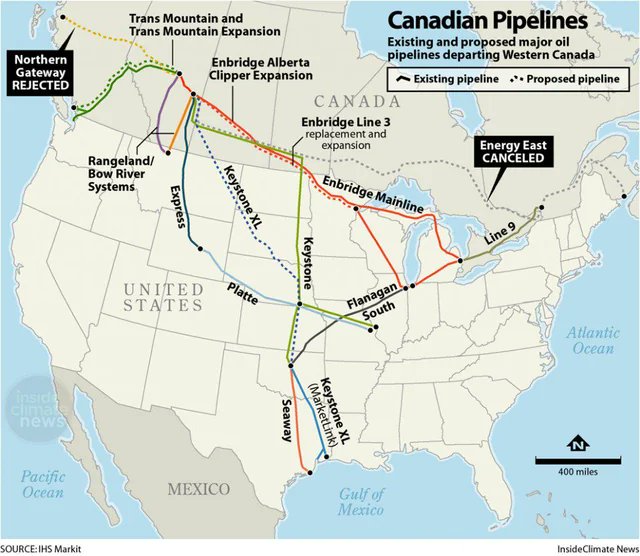
Making Canada noncontiguous is strategically valuable to the US, because it makes British Columbia dependent on transportation through either the US or Alberta. And it gives the US a bit more of a veto over Canadian military influence in the Pacific.
The US needs a steady supply of Saskatchewan potash. Few parts of the world can produce this category of fertilizer, and it’s a necessary category for preventing the world from catastrophic mass starvation. Removing it from a sovereign state like Canada to a smaller, more dependent state like Saskatchewan makes trade negotiations easier.
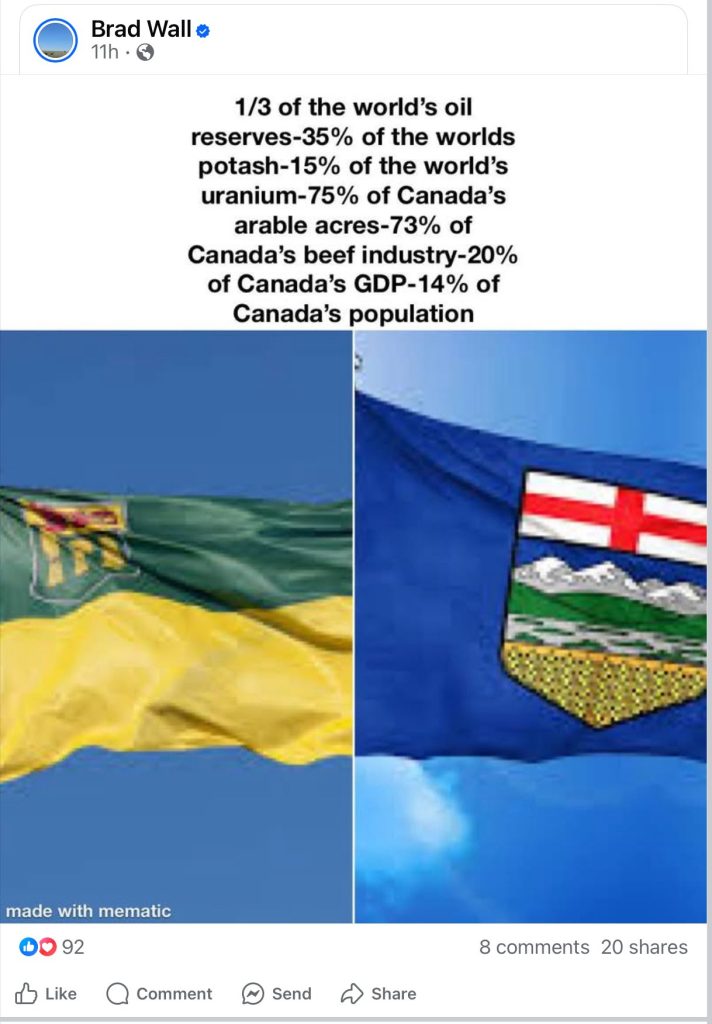
Of course, if Alberta & Saskatchewan choose to join the US, annexation would be a great boon to the US. We wrote an article about it here.
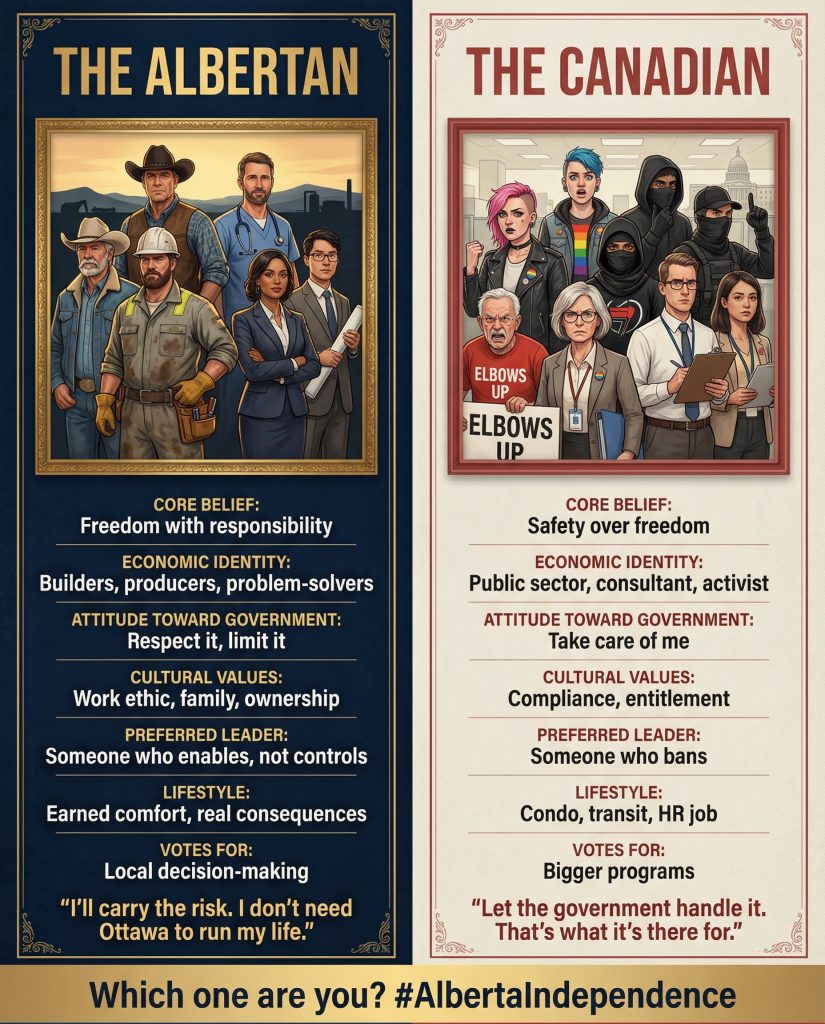
Does Trump want Alberta?
Trump has repeatedly floated the idea of Canada joining the United States:
- He has said things like “Never say never” to Canada becoming the 51st state and suggested that “if people wanted to play the game right, it would be 100% certain that they’d become a state.”
- He has posted images on Truth Social (and shared in the Oval Office) showing a map with the U.S. flag covering Canada (and sometimes Greenland).
- He has criticized Canada sharply, claiming “Canada lives because of the United States” and warning that China could “devour” Canada without U.S. protection.
These remarks are about the whole country, not Alberta breaking away on its own. But this is just rhetoric meant to make Canada humble about its vulnerabilities. He’d never go through with it because eastern Canada has horrible voters. Even if you make it a non-voting territory, it would still influence elections through media, money, and activism, as we explained here.
- U.S. Treasury Secretary Scott Bessent (a senior Trump Cabinet official) said in January 2026: “Alberta is a natural partner for the U.S. … They have great resources. The Albertans are very independent people.” He also mentioned rumors of a referendum on whether Alberta wants to stay in Canada and suggested the U.S. could accept more Alberta oil via pipeline.
- The Alberta Prosperity Project has met multiple times with Trump administration officials to discuss recognition, pipelines, currency (U.S. dollar), and even potential U.S. financial support (e.g., large loan guarantees backed by Alberta resources). The separatists described the tone as positive and “heartening,”
- Some Trump allies and family (e.g., reports involving Baron Trump in commentary) have floated a “two-step” idea: Alberta secedes first, then potentially joins the U.S. as a state.
Will the government of Alberta respect the result of the referendum?
Premier (governor) of the province, Danielle Smith said that the independence question will be counted first in October. Only if that question is a “NO” do the other nine questions come into play, because if independence passes, it becomes the defining result of the entire referendum. This proves that if it passes, then Smith will work for actual unilateral secession, not use all 10 ballot questions to try to extract concessions from the federal government.
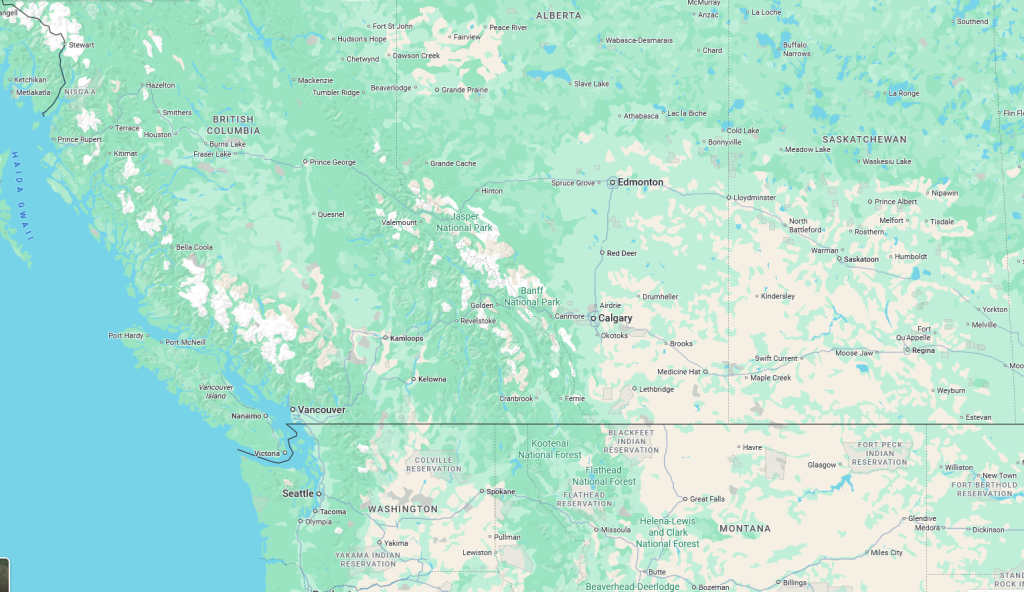
Why would a landlocked province declare independence?
If Canada embargoes or over-tariffs Alberta, Alberta can embargo or over-tariff British Columbia’s trade through Alberta rail lines and highways. If Canada blocks airspace, Alberta can block British Columbia’s paths East too.
Admittedly, if a future Dem US president chooses to join Canada’s embargo, then Alberta will be in a tough spot. But trade would still be difficult for British Columbia, as routing everything through the US is inefficient. There is no rail line connecting BC’s northern ports to southern BC or the US, except routes that go through Alberta. International shipping through northern British Columbia (mostly via Edmonton Alberta) is 17% of the dollar value of southern BC shipping, according to Grok’s estimate.
This teaches us something about US red-state secession. Blue-state ports are the most efficient shipping points for parts of the future red-state federation. But blue states will also rely on the federation for land and air routes between blue states, especially between the East Coast and West Coast. Besides, the federation will have plenty of ports on the Gulf and southern East Coast.
The US is not organized as a single row of states, so we don’t believe a land-locked US state can lead the US secession movement.
Alberta voters are weak on independence. What should the YES campaign do?
Alberta’s independence movement is producing a lot of great memes – the best secession memes & videos I’ve seen from any movement in the world. It has a healthy movement with many talented volunteers. As far as I can guess, there’s some money behind it too, and it’s easy to understand why the oil & gas industry would bankroll it.
This will all be necessary, because polling of Albertans has been disappointing so far – around a third of voters support independence, and not much more than half of the province votes Conservative Party most of the time anyway. Polls of Saskatchewan haven’t polled enough respondents for a clear picture.
Even 50.1% of the vote might not be enough, depending on how Alberta’s government reacts. From the point of view of the federal government, the Clarity Act says that fedgov is required to negotiate if there’s a “clear majority,” which is usually interpreted as meaning 52% or 53%. If Canada fails to ratify a constitutional amendment, Premier Smith might be afraid to implement unilateral secession, as Alberta could be ripped apart if the vote isn’t even stronger mandate than that.
On the bright side, many winning campaigns have begun with weaker support, such as BREXIT. Opponents to BREXIT were lulled into a false sense of security by their disdain for deplorables. But there’s a lot more money to potentially donate in the 88% of Canada that isn’t Alberta than in Alberta, and establishment figures & institutions will side with the 88%. Fedgov has a vast patronage scheme.
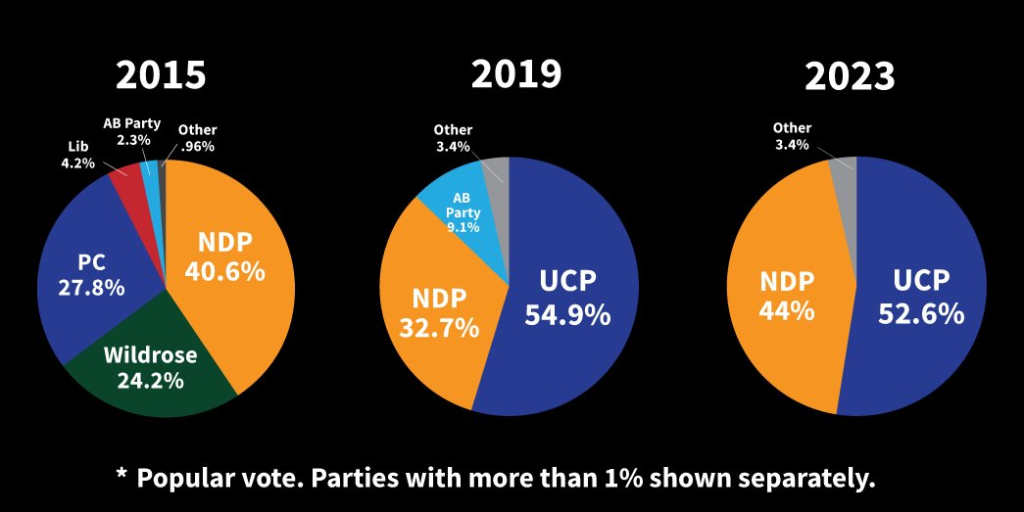
The Alberta independence movement has a problem: a polls showed it only gets approval from 2% of NDP voters & 0% of Liberal voters. It gets the support of 73% of Conservative Party voters, but 73% is not enough to win. Conservative parties themselves got the support of 55% of Albertans in January’s Leger poll of Alberta, but got 64% of Alberta’s federal vote in April 2025 elections. Still, the independence movement gets weak support from any age group older than Millennials. It might be impossible to get 90% of the conservative vote, because the cost and risk of a radical change doesn’t have many years to pay off for old people, and unfounded concerns over pensions. Only the young are bothered by the increase in housing prices caused by Trudeau Jr’s outrageous mass immigration.
One would think that Albertans who aren’t conservative would still care about growing their oil industry that funds their provincial government’s spending, but some have probably been indoctrinated into the climate cult. Perhaps appeals to state pride, and the disdain and abuse from eastern Canada can help. Ironically, Trump himself is part of the problem: his comments about Canada have sparked anxiety, TDS, & defensiveness from cat ladies across the country. TDS is so severe outside the conservative party, that Canada patriotism was at the highest level in living memory in 2025. So it’s hard to make inroads among non-conservatives.
Should the Alberta independence movement:
A. Continue their conservative messaging to try for 90% of the Conservative vote, or
B. Try to add one third of the non-Conservatives’ vote by switching to exclusively economic or state pride messaging, forgoing culture-war issues?
Impact
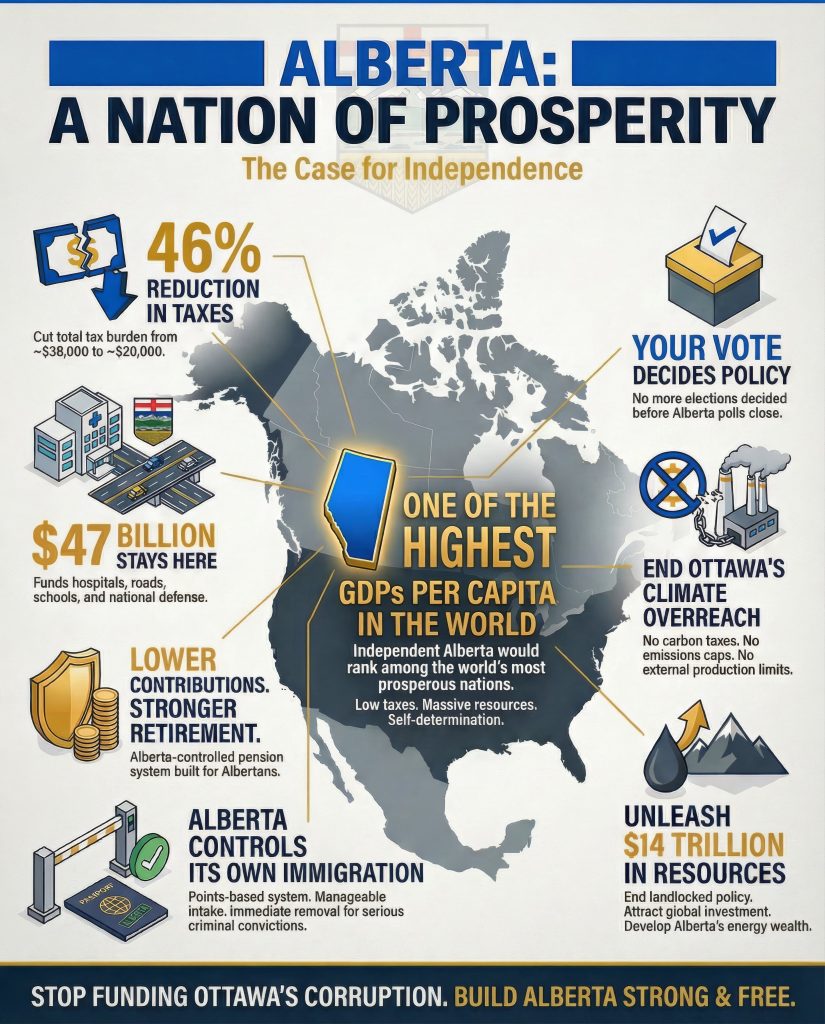
If Alberta becomes independent, it will become easier for red states to break free from the US, because it will become a category in far more minds, just as the extensive media coverage of the Greater Idaho movement increased energy in movements to relocate other state lines. Perhaps some of you would choose to become a citizen of Alberta or Saskatchewan. You can donate to the organizations linked above, or buy merch from the volunteer who makes a lot of the best memes.
Talking about making Alberta the 51st state is actually harmful to the campaign, because it’s very unpopular with swing voters in Alberta.
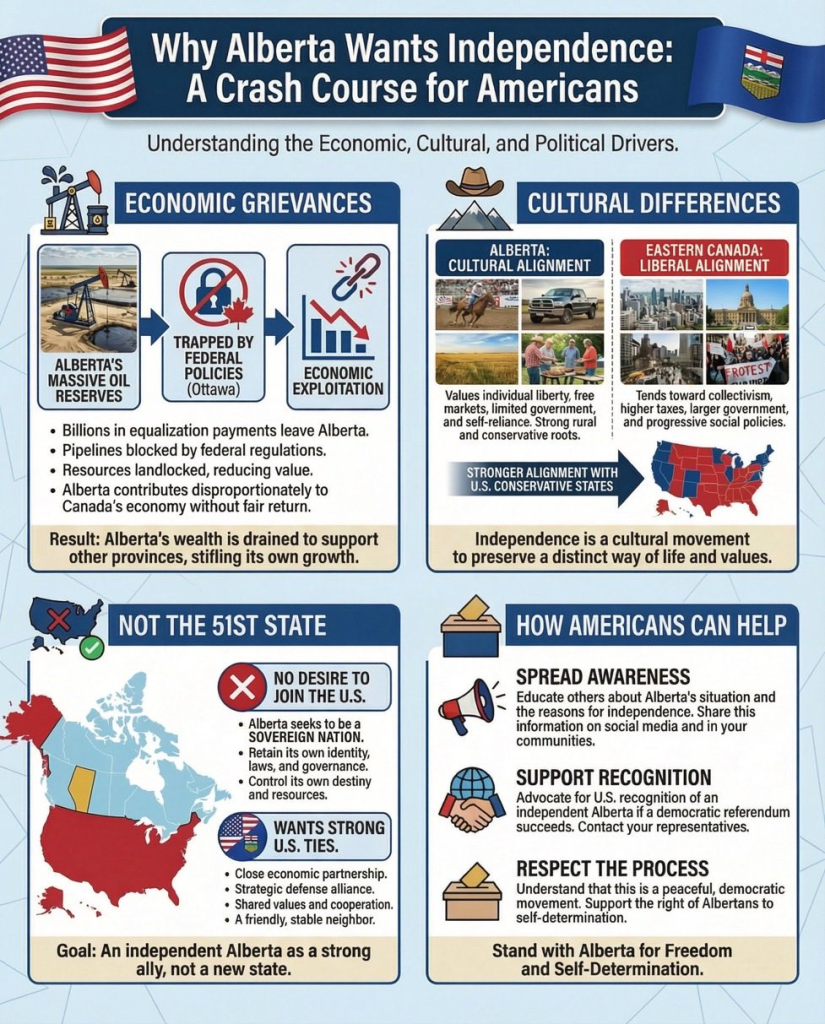

This will be an exciting campaign. We recommend you follow:
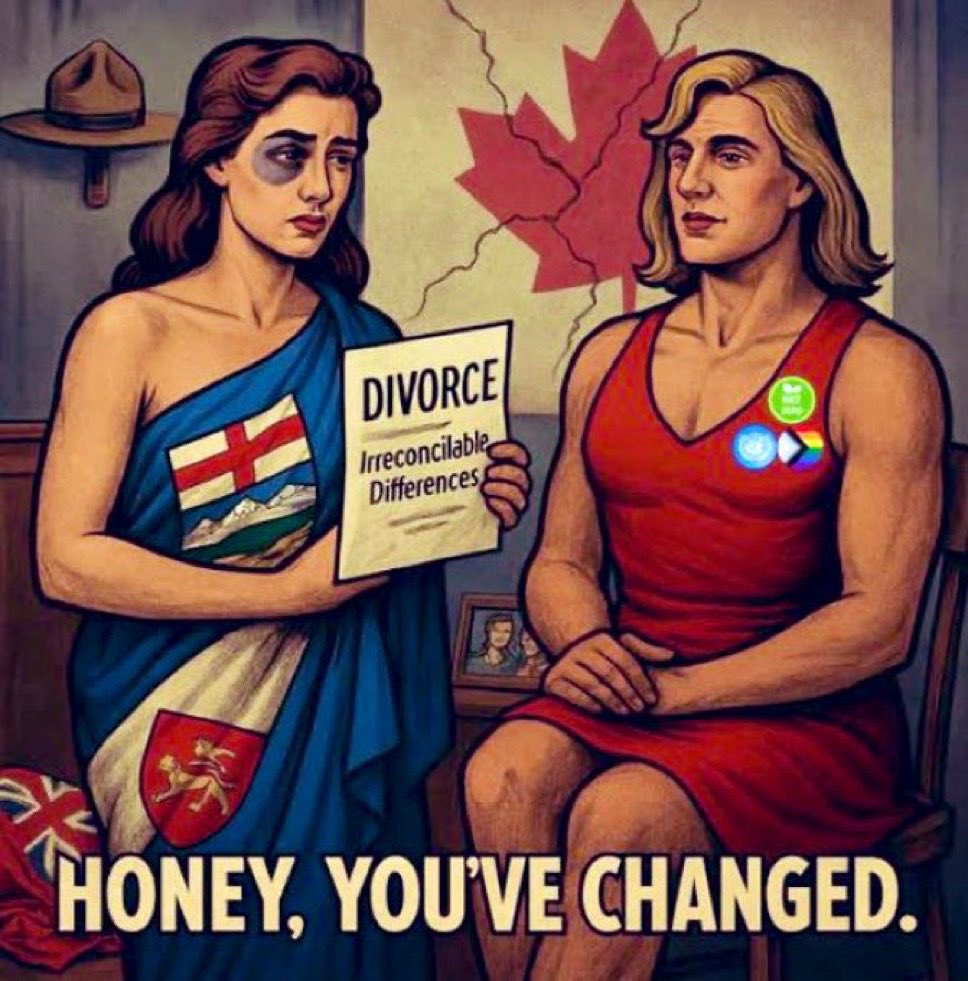
You forgot to mention:
Alberta has the third largest Lithium reserves in the world.
Stripping technology for helium.
Untold fresh water.
Silver mines in development.
Established coking coal mines for steel mills.
Raw feed stocks for multiple industrial needs.
Lumber. Beef, Pork, Poultry.
Seed oils,