
Politico reported that Norfolk Island voted recently to secede from Australia. Norfolk Island has a population of 2200 residents, almost all white. It’s located between Australia & New Zealand. You might think the size of its population precludes independence, but this article will surface reasons a small island can survive. Now we’ll admit to you that, actually, Politico vastly exaggerated what Norfolk Islanders voted on. Yet still, the idea of Norfolk secession turns out to be a great thought experiment.
The security situation of this island is interesting because fishing revenue in the waters around the island, including the whole EEZ, are utterly insignificant, except to the extent that recreational fishing lures tourists there. Tourism is its primary industry. This means that there’s nothing to draw a potential hostile conqueror to the island that would justify the consequences of such an action (except the potential possibility of offshore oil, if it is ever deemed worthwhile to explore for oil). The island doesn’t even have a dredged channel that would allow ships to reach its jetties (cargo ships are unloaded offshore by local small open boats). Thus, its potential use to the Australian military would be limited to being a potential location for radars, antennas, or a search & rescue team, at most.
Can such a tiny country survive in this world? If the residents purchase firearms and some other weapons, why not? The risk to Australia of a cascade of secessions is small; the two other populated external territories of Australia have even less population: Christmas Island pop 2k and Cocos Island pop 650. So they’re probably not prized either.
The island can be expanded by piping many tons of material from the sea floor to the top of its sea mount, and then reinforcing the edges with concrete, just as China has done in the South China Sea. Although the island is small, Norfolk has an underwater plateau of perhaps 1200 square miles that isn’t far below the sea’s surface, judging from the map below. This would make Norfolk half the area of Luxembourg, and much larger than Singapore, Bahrain, or Malta. In fact, 25 members of the UN are smaller.

One of the primary data points on how countries react to micronations is the saga of the Republic of Minerva. The Minerva Reefs are subsurface reefs a couple hundred miles from Tonga, hundreds of miles east of Norfolk Island and farther north of New Zealand. Briefly, it is reported that an American investor had sand from Australia dumped onto some of a Minerva Reef in 1971, bringing it above sea level at high tide until washed away decades later. Governments in the region responded by deciding they didn’t want a new state there, and so assigned the reefs to the Kingdom of Tonga (pop. 100k). Some American libertarian adventurers were forced off the island by the Tongan Navy during their brief visits in 1972 & 1982, whereupon they gave up.

Clearly, the people of Norfolk Island have orders of magnitude more staying power (self-sufficiency) than the visitors to an isolated pile of sand; would willingness to wipe it out be that much stronger? Much more than a visit by a naval vessel would be required for their expulsion. But there are other ways to apply pressure. Norfolk is served by commercial flights from Australia & New Zealand. These two countries have immense leverage over Norfolk because the island depends on tourism. A ban on these flights could perhaps provoke the scheduling of a new periodic flight from another country in the region such as Fiji (pop 900k), Tonga, or Samoa (pop 200k). But perhaps Australia & New Zealand could pressure these countries to form a united front as in 1971 with Minerva Reefs. It’s not certain. At that time, Australia was the primary power in region, but now China competes for influence with island nations there. And Fiji’s politics have been colorful.
Because of its dependence on tourism flights that might be cut off, independence for Norfolk might require a sudden switch to another industry such as crypto, or becoming a tax haven, or being funded for a transition period. The funding would come from an investor motivated by the desire to create a new country of a particular ideology or religion. But that kind of investor is more likely to choose an island where there’s no inhabitants to oppose & block the investor’s plans to change & unify the ideology or religion of the island.
Without enough population to support a medical system, regular commercial flights are important to help keep sick or elderly people on the island. For emergencies, private planes can be chartered, but some types of medical care or medical monitoring happen more often in a person’s life, even in an age of telemedicine. The expense may be out of reach of the lower class or chronically sick. This is why an independent island with a small population can thrive better with a tourism industry – more flights. Admittedly, remote areas all over the world lack regular inexpensive flights, even in Alaska. But for first-worlders, keeping the elderly & fail sons on the island can be the difference between feeling like a nation or a remote work camp. So independence is more likely for an island that is close enough to countries that are rich enough for tourism, that wouldn’t form a coalition against the island. Or within a quick sail to multiple states that do have such flights, and won’t all be hostile at the same time. Another option is being desirable enough to attract tourism from around the globe.
For consideration of creating a new country on an uninhabited island, perhaps only young healthy families, a midwife, a nurse, and Starlink for telemedicine would be enough for the first decade of the country’s existence, before flights begin.
Network States
If Australia objects to the secession of Norfolk, it could arrest Norfolkers who visit Australia on charges of sedition, or ask for the extradition of Norfolkers who are in other countries in the region. This is a possibility unless Norfolkers find a way to become so politically powerful internationally that Norfolk Island is awarded the status of a UN member. Otherwise, Norfolkers need to have leverage against larger states that increases the costs of persecuting Norfolkers above the benefits of persecuting Norfolkers.
US AG Janet Reno’s bombing of the Branch Davidian cult at Waco, Texas shows that Leftist governments can find an excuse to bomb a group of right-wingers (RW) who don’t have a protector state, if they aren’t intermixed with many innocents. This is an argument against starting with an uninhabited territory, because a RW project will only attract RW residents, who won’t be considered innocent by Leftist governments. In the US, fedgov does not allow US localities to bar US citizens from moving in. That’s an opportunity; by migrating in, right-wingers can become the majority of a pre-existing US county (county, not country) that has sufficient innocent residents (this is analogous to the libertarians’ New Hampshire Free State Project). Our thoughts on the difficulty of beginning secession from a single US county are here.
So creating a successful new first-world country takes money and influence. Network states, as described by Balaji Srinavasan, have that even before they have land. Jews are a network state; a group of people whose power and mutual loyalty (at least among core members) is state-like even though its citizens all, or mostly, live in other countries outside of a homeland (if any). While financing war efforts of WWII, Jewish bankers had the influence necessary to gain Allied support for creating the state of Israel, with the territory there. A network state has permanency of orientation (goals or identity), whereas the support of a wealthy, well-connected benefactor only lasts while the benefactor is living and agreeable.
Mormons could become a network state, and then reclaim land on seamounts. These could become a new homeland free from interference from fedgov tyranny. Or they could afford to purchase uninhabited or virtually uninhabited sovereign islands from existing states. We mean not only purchasing title to the land, but purchasing the parent state’s relinquishment of sovereignty over the island and the island’s EEZ. This might include creating a military alliance with the parent state. Mormons have significant influence in the CIA, US Senate, and fedgov in general. This would help prevent the new Mormon homeland from being snuffed out.
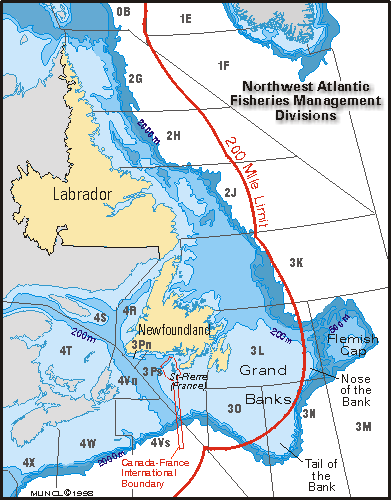
There are millions of Mormons (18M worldwide), but there are also vast seamounts that can be raised to make new lands. North America’s continental shelf extends 100 miles beyond Canada’s (200 mi) EEZ to the east of Newfoundland, where the depth is only 50 meters below sea level (the Nose & Tail of the Grand Banks). The Tail is at the same latitude as the southern edge of France and Milwaukee, and it’s directly in the Gulf Stream of warm currents. There is also a constant stream of cheap shipping passing by, between the world’s two great consumer markets.
There are many other possibilities, such as truly large uninhabited islands. We’re not implying that new countries can employ & sustain everyone who wants to move there. Mormons will still remain in other countries. But a new country can provide not only refuge from tyranny, but also an inspiring example of what a Mormon state would look like, just as Plymouth Plantations were an American “City on a Hill” to demonstrate to Englishmen still in England the beneficial effects of unrestrained Puritanism on a whole community. It was also a place where Puritans could develop their ideas, teach, organize, and print subversive literature without government interference. After 40k Puritans fled England for New England, the example of New England helped inspire Puritans to overthrow, in England, the anti-Puritan King of England & his supporters. This is the concept of “fight by flight.”
The Catholic Church is also a network state, but it isn’t right-wing at the moment, so its leadership feels no need to escape globo-homo by acquisition of sovereign territory beyond the Vatican grounds. In the West, no other suitably populous right-wing groups come to mind that have the mutual loyalty required for the intense capital expenditures and long-term sacrifices necessary to create a new country on the seas.
Other thoughts
The whole globe has been evaluated for its suitability to seasteading, as follows (green = good):
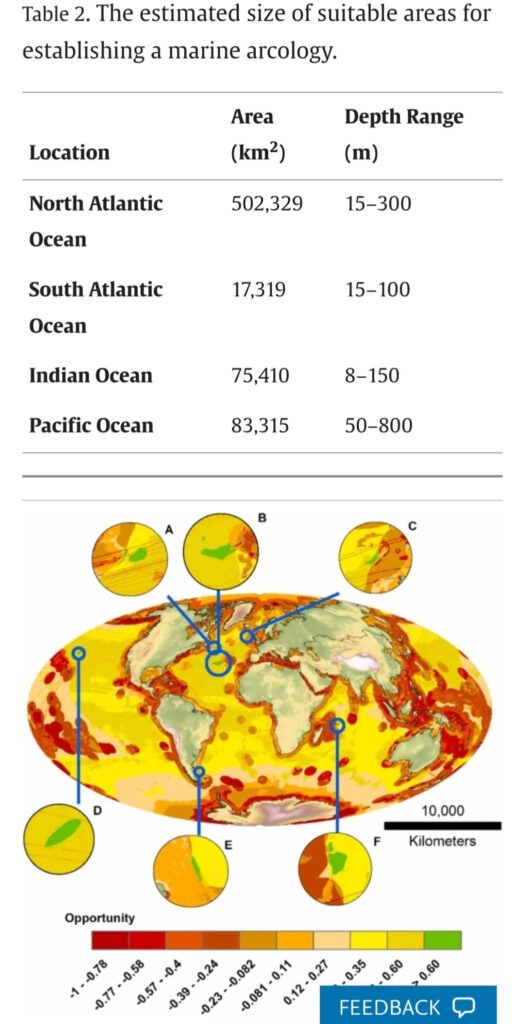
Inset:
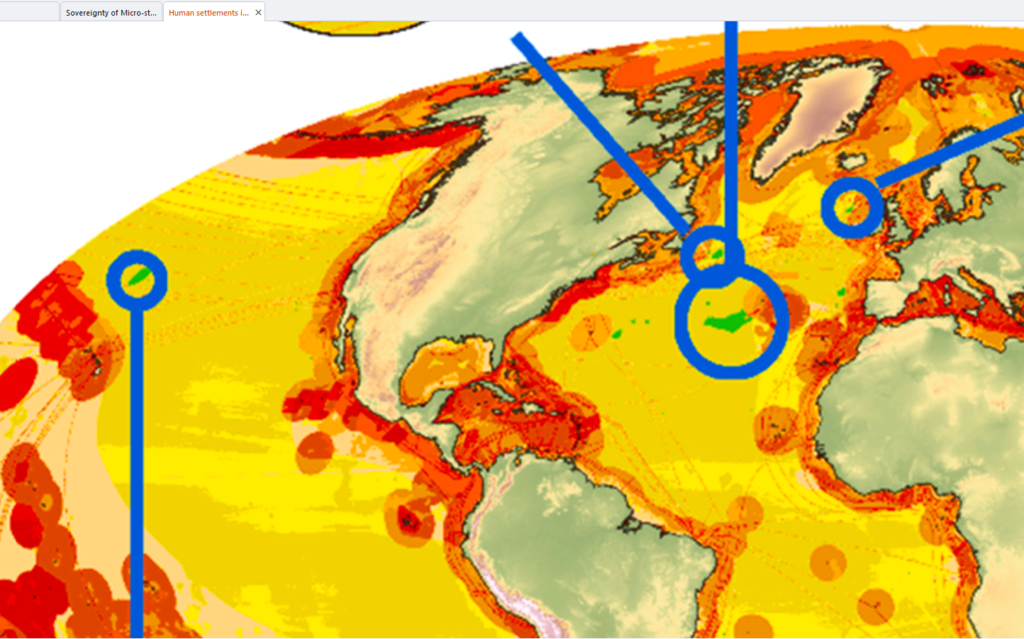
Unfortunately, all of the Mediterranean & Caribbean is in an EEZ, except some deep water in the Gulf of America & east of the Caribbean.
There may be other reasons that such a small population makes true independence unrealistic. Besides the Vatican, the least populous member of the UN has 10k (Tuvalu). This essay is about truly independent countries, not countries that are dependencies of others. Although Tuvalu has been independent since its secession from the UK, the other two smallest countries are client states of Australia & the US; Nauru seceded from Australia in 1968, Palau from the US in 1994. A dependency can be pressured to bend on culture-war issues by a liberal state, or on religious issues by a state that doesn’t agree, or on handling internet “crimes” involving crypto, political “misinformation,” racism, etc. On continents, independent microstates such as Liechtenstein (pop 40k), San Marino (pop 34k), Monaco (pop 39k), etc survive by complying with their neighbors’ wishes on such things, because crossing a land border is easy for citizens, contraband, and militaries. Thus the focus on islands here. With the addition of the US dependency Marshall Islands (42k), this paragraph has now mentioned the 8 least-populous member states of the UN.
Outside the scope of this essay is the idea of a good alliance with a naval or economic power who would give your new country a free hand on the issues you care about (without simply annexing your island).
So here’s a few criteria for choosing an uninhabited island for your new country:
– potential for a non-small population, and a plan to achieve it (including plans for livelihoods and some self-sufficiency)
– no inherent value great enough to cause a military expedition from the mainland or another government – no minerals, commercial fishing, or predicted offshore oil. The wealth must come from labor, not directly from the territory you’re taking.
– plans for deserving adequate air flights within a decade or two, without reliance on a potentially hostile block of destinations
– the project needs citizens who have leverage over potential persecutors. A network state can provide leverage.
This blog has always focused on the secessions of millions of first-world Americans, who would be too economically powerful to need UN recognition, and whose UN recognition could be stymied by the US anyway. But anyone interested in creating a new mini-state will want to read a recent book about the international “law” regarding obtaining recognition of a new state by Dr. Qvortrup, or perhaps James Ker-Lindsey. This whole essay has been inspired by, and in a few places leans on, the work of Richard Duwell-Trumbell on seasteading. His Substack has highlighted many potential locations for new states. As for ourselves, we did a little economic analysis on the minimum ideal size of a modern industrial state, which is summarized here.
To avoid forgetting all about our wonderful website, subscribe to our free Substack to get a few articles per year in your inbox. Or our social media.