
Some US states have less than a million people. Clearly, it’s possible to be a country with a small population, since 42 UN members (countries) have less than a million residents, mostly island nations. But perhaps their populations would be happier and stay employed better if they formed a federation with several states.
EU citizens have permission to reside & work in any EU country. This might not be the case in a future federation of US red states. Perhaps a future federation of red states will not have a common citizenship but state-by-state citizenship instead. Or maybe you’ll only have automatic permission to be resident in another state if it’s a part of your state’s sub-federation. This might happen if Southerners don’t want immigration from northern red states (to preserve culture), or vice versa (to preserve the racial & ethnic demographics of northern red states). In this case, should Wyoming seek to merge with other states, or form a federation or sub-federation with them? And how populous should such a group be?
This article focuses on one aspect of this question, using “native retention rate” data. The second part of this article looks at some aspects of security issues. The last paragraphs have links to our articles that consider other aspects of the question.
We use “native retention rate” data to determine how populous a country needs to be to meet the needs of its people for lifelong employment & higher education, so that they won’t want to emigrate. We discover that the number is a minimum population of four million.
How we arrived at a 4 million minimum for employment:
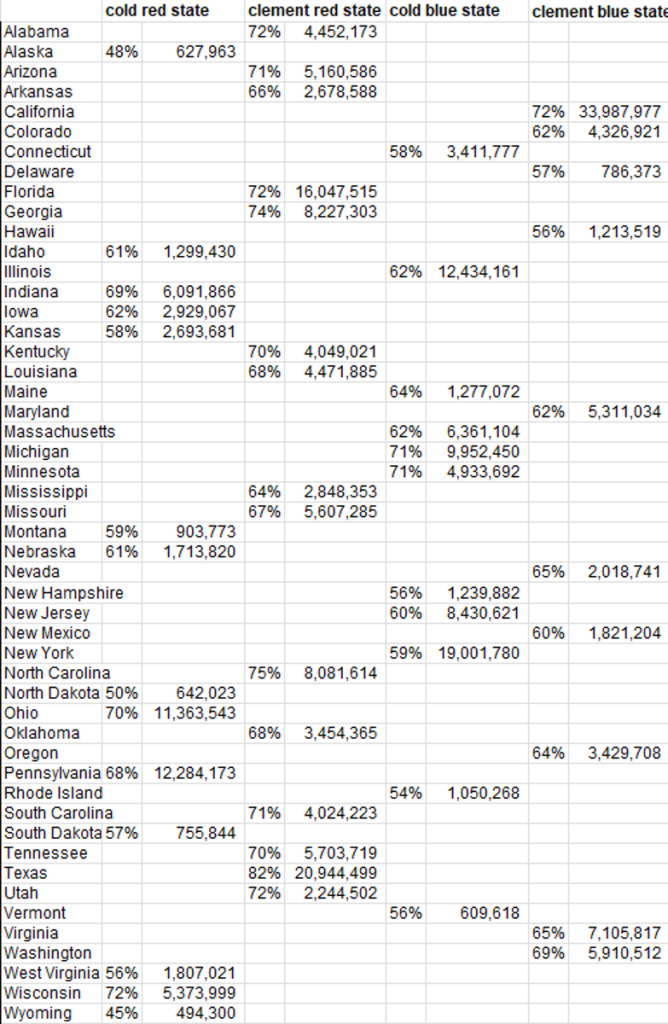
We use US state data to determine this number. Emigration from a country is harder than emigration from a US state, for reasons of language, culture, allegiance, and immigration law, so US states reveal the emigration rates that could only be desired, but not fully realized, in nations with small populations. A state’s native retention rate, or “stickiness,” is the percentage of Americans in the US who were born in a state that are currently resident in that state. It’s the number of a state’s natives who reside in the state, divided by the number of the state’s natives. The average is 68%. As of 2024, Texas has the highest native retention rate, at 82%, meaning only 18% of its natives live in other states. But Wyoming has the lowest rate, at 46% homegrown. 54% of its natives live elsewhere in the US, a much bigger number than Texas’ 18%.
The creator of the maps below wrote an article about it.
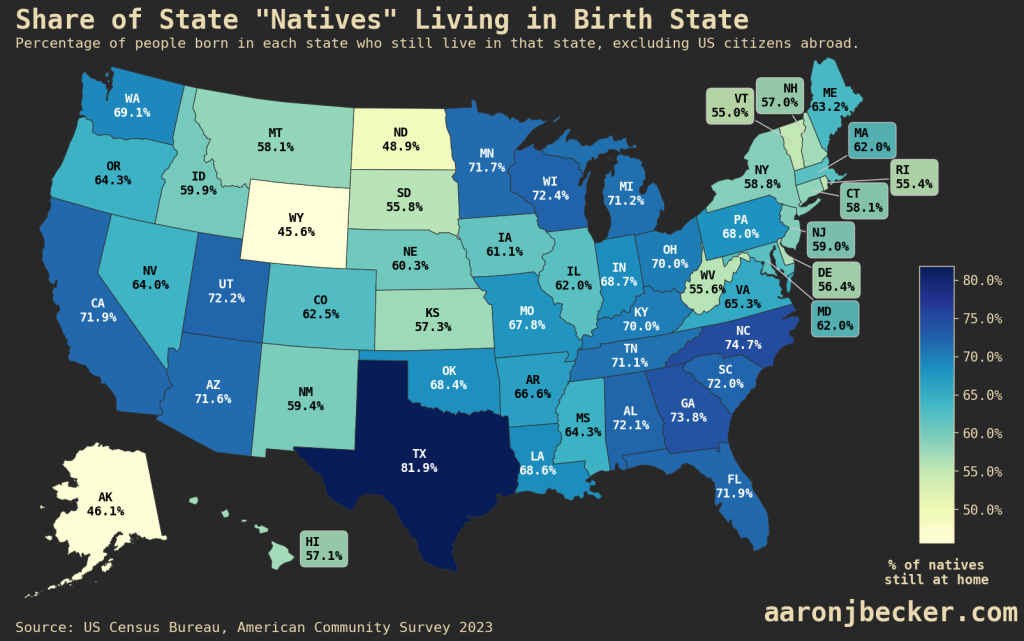
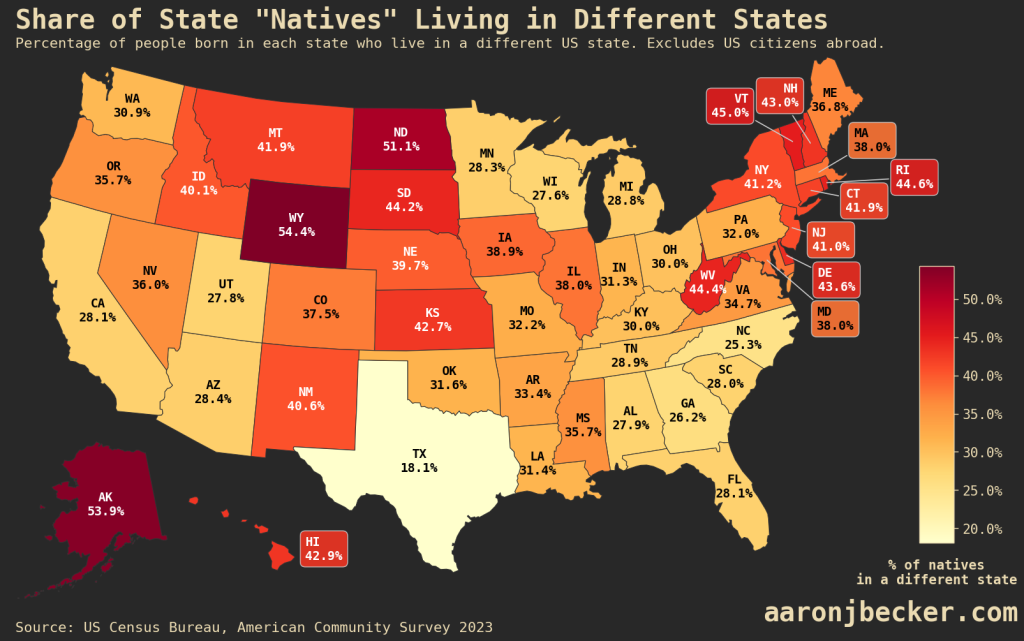
Based on these maps, we surmise that Wyoming’s small population is not adequate to provide adequate higher-education options and employment options as industries thrive and whither throughout a career. This has caused emigration of natives. Admittedly, it’s a cold and dark place to live in winter, but more populous places with the same problem have better native retention rates. The coal industry in Wyoming & West Virginia etc. have declined dramatically, but Rust Belt states of the upper Midwest (WI, MI, MN) that had severe downturns in manufacturing employment have better retention rates, probably because they’re more populous. And they’re cold & dark in winter too.
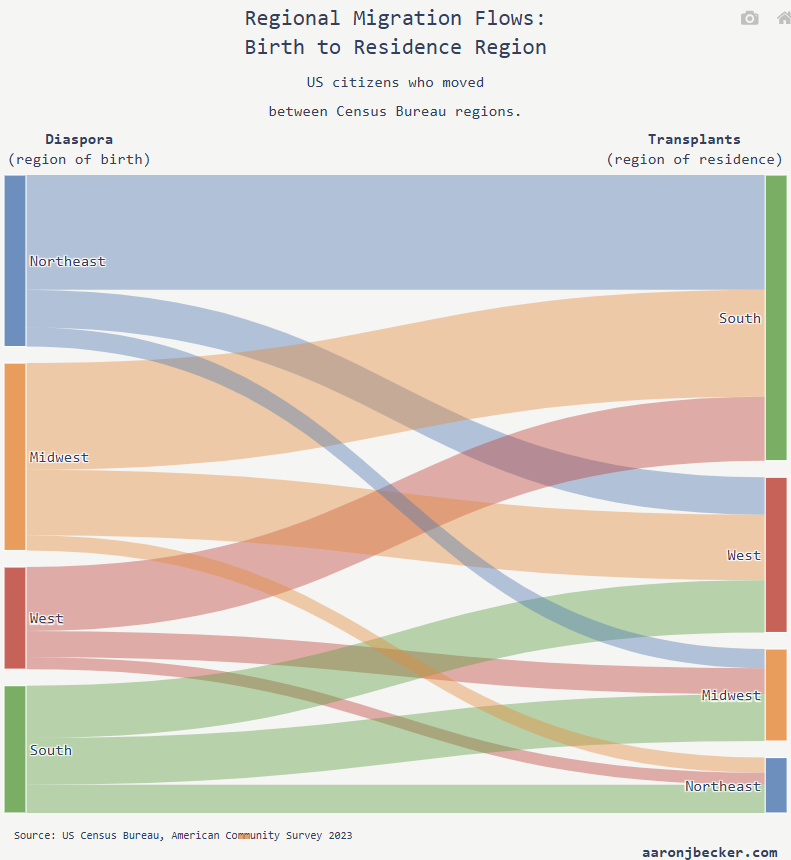
The following chart shows only people who were born in one region of the US and live in another. It dramatizes the migration to the South to avoid cold winters and to find employment where employers set up shop to avoid the extortionate and unproductive labor unions of the North. To be specific, most of the migration is to the Southern states that are on the Atlantic Coast.
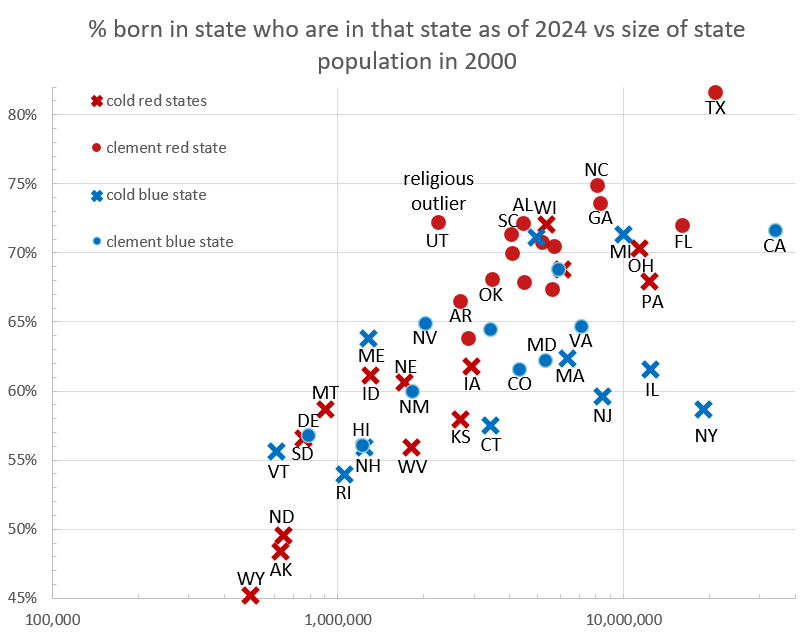
graph by RedStateSecession.org using Census data
This graph’s horizontal axis is logarithmic. We see a clear trend from bottom left to upper right: the least-populous states never have high retention rates. The other states never have low retention rates. The upper edge of this data is more important than the lower edge. There are many reasons a state can have low retention, besides low population, and these reasons will cause the lower edge of the grouping to be erratic. The upper edge shows that low-population states never achieve good retention, but high-population states can.
Utah is an outlier from a curve fit (trend line) of this data. It has a much higher retention rate than other states with its population, presumably because it was more than half Mormon until very recently, and Mormons who wish to live in majority-Mormon communities don’t have a lot more (populous) options beyond Utah & eastern Idaho.
We see that red states have higher retention than blue states. Cold states have worse retention than clement states. Cold red states have much higher retention than cold blue states, and clement red states have much higher retention than clement blue states. No clement red states have retention rates below 64%, but 5 blue states do: Hawaii, Delaware, New Mexico, Colorado, and Maryland. Red states tend to follow a pattern of more populous states having higher retention rates, but blue states New York, Illinois, and New Jersey fall far below this trend.
These three states have a significant amount of their population near a state line, which will tend to encourage crossing state lines, thereby artificially making their population seem dissatisfied with the state when really people are just moving around a metro area. But this is a problem for most US states. But New York and Illinois don’t actually have a large percentage of their natives in neighboring states. Only 3% of Illinois natives are in Indiana, and not all of that is Chicagoans living just across the state line. The same percentage live in Wisconsin, even though Chicago is not in the same metro area as Milwaukee. It’s normal for many emigres to move to a neighboring state. 2% of Illinois natives are in Missouri. 4% are in Florida, 3% are in California, 3% in Texas, and 2% in Arizona. Regarding New York natives, only 6.5% are in New Jersey or Connecticut. Regarding New Jersey natives, 4.5% live in NY or Connecticut. And 5.6% live in PA. A better explanation is that the higher taxation and regulation of these 3 blue states, and blue states in general, reduce employment and increase cost of living, driving emigration. 6% of Connecticut natives live in New York or New Jersey.
Clearly, Wyoming (and Vermont) haven’t had an adequate population size. But South Carolina has a retention rate of 71% with a population of only 4M as of 2000 AD. And several other states are near SC on the graph. 4 million seems quite adequate, but it appears that larger population is an advantage across the full range of the graph. While populations above 4M aren’t, on average, much higher in retention rate than populations of 4M, this might be partly explained if NJ, IL, & NY are considered outliers.
There are many factors that influence a retention rate, including urbanization. US population was initially dispersed across the country to work fields & ranches. Since then, excess population has tended to move toward cities, especially megalopolises that attract the businesses that require many employees with a wide range of very specific experiences or skills. Yet some states that are more urban than the US average, such as Rhode Island, Massachusetts, Hawaii, and Illinois score below the curve fit of our graph.
One might say that the causality goes both ways. Are people moving away because the population is too small, or is the population & retention small because people keep moving away because there’s never been much reason to live there besides Ag/mining/ranching/forestry? Are the population & retention both big because people always want to move there & stay there because of something inherent in the culture or economy of that particular state? But there are plenty of states that are equal in terms of their inherent goodness, yet they have different retention rates. Local variations and many factors explain why the graph is scattered rather than a straight line. Our point is that it’s not random, but slightly linear.
Note on why we chose the 2000 population data, not 2024: The median age of Americans was 39 in 2024. But people under age 18 aren’t involved in decisions about relocations. The median adult is probably 50. People are most likely to move for college or early career, and then marry into a location. So 24 years prior to 2024 was when the typical adult was deciding where to live (at age 26), and the size of the state he was in at that time was more influential that its 2024 population.
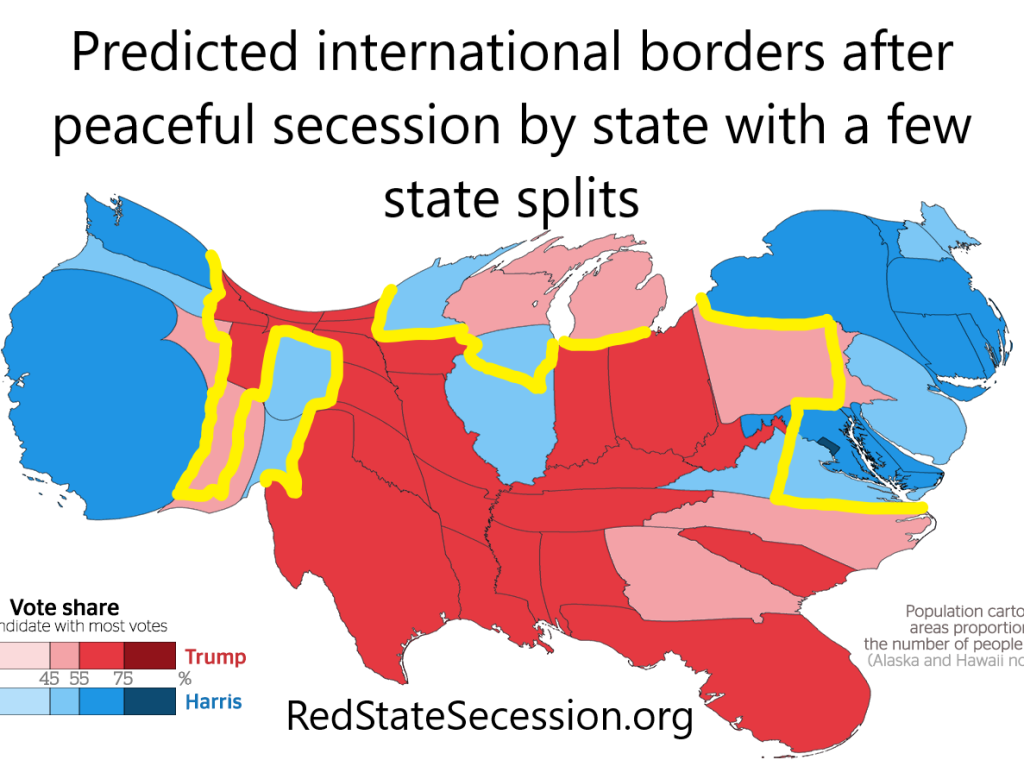
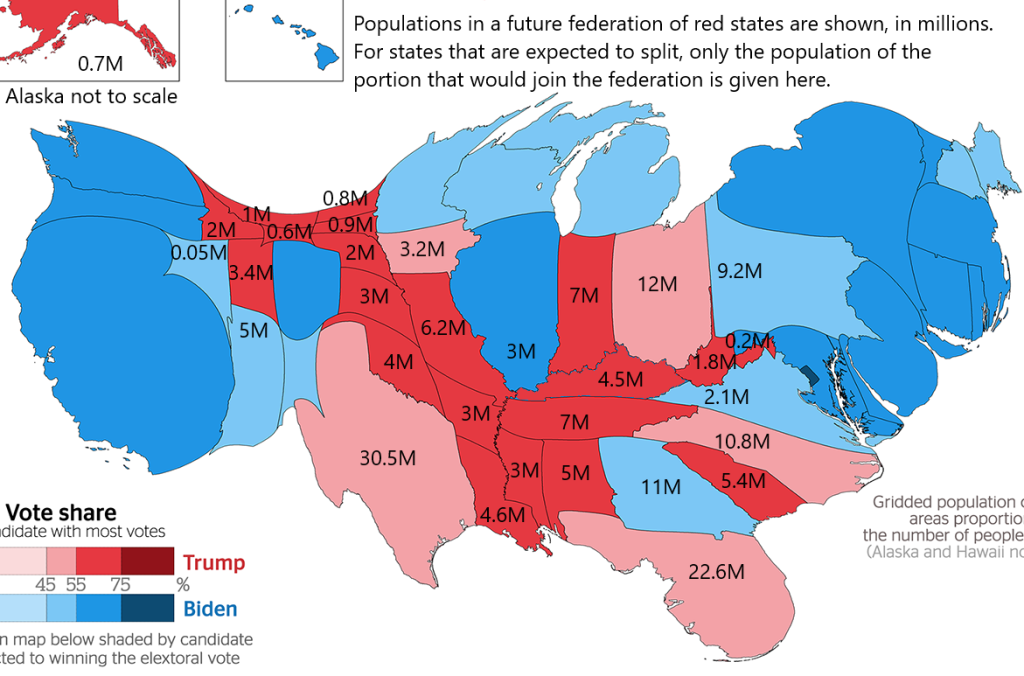
Consolidation of small states in a federation of red states
A few red states are ridiculously unpopulated in proportion to Texas or Florida. Wyoming (pop 0.6M) has 2% of Texas’ 2026 population of 32M. If they want to be treated like a sovereign state in a world of 8B people and have influence in a future red-state federation’s decisions in whatever senate or military councils are created by the new constitution, we’d expect Idaho, Wyoming & Montana to relate to the federation as a single federated unit, and likewise ND, SD, NE. This might mean that they choose a delegate to represent each trio of states. Of course, larger sub-federations would be welcome. We don’t really expect Utah to join another state, even though eastern Idaho is still Mormon. WV would join western Virginia after Virginia splits again. And western MD would be annexed by either WV or western PA after MD & PA both split. If Illinois splits, downstate Illinois can be annexed with a neighboring state. Alaska (& Guam) is not contiguous with a US state, but it might join a red state on international waters & airspace, such as Texas.
If red states go through the disruption of secession to get their independence, they’re going to prize their new sovereignty. We think they’ll form a loose federation, in which the federation’s government is limited like the US government was before the Progressive movement of 1900s to just defense & foreign affairs. This means that every red state should join – there’s no downside, and the upside is avoiding bullying from the blue states (the US).
The states can share a Space Force, bioweapon defense, military R&D & procurement etc despite having different citizenships, just like before the 14th amendment your citizenship was with your state, but you still participated in Indian wars with citizens of other states. But each state might have its own military, like they currently have their own National Guards (& state guards). This provides an incentive for the federation government to avoid overreach. There would still an adequate amount of military coordination & organization at the federation level, as each state’s National Guard is coordinated with others today. Hopefully, red states will get their share of federal assets, such as military equipment, in return for taking their share of the federal debt.
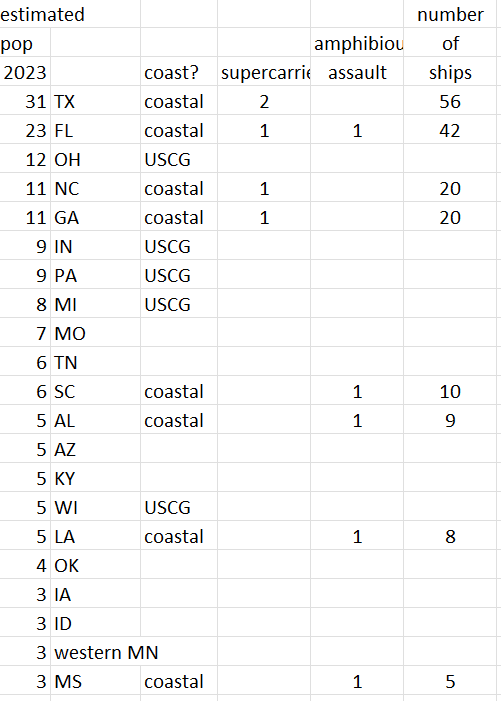
Our point is that these small groups of states, even if they choose not to merge into single states, should consider sharing their military allotments in common to avoid duplication and save money. This allows having some of each major type of aircraft, for example. For the common military aircraft models, Americans have 1 or 2 per million citizens. Overall, Americans have, per million residents, 0.4 bombers, 9 fighter aircraft, 1.3 special ops aircraft, 1.7 reconnaissance aircraft, 1.7 military tankers, 2.6 military transport, 16 military helicopters, and 5 trainer aircraft. Landlocked states, having half the population of the red-state federation, would get more Air Force aircraft and Army equipment than average, since they would take little to none Navy ships, Navy aircraft, or Marines equipment. The US has more than 13 tanks per million citizens.

Americans have a little less than one US Navy battle force ship per million residents, and less than one transport ship per 2 million residents. The paucity of Navy ships is one reason Alaska will probably want to join a populous coastal state. Forming into a larger group also allows one state to share in the ballistic missile silos that another state has.
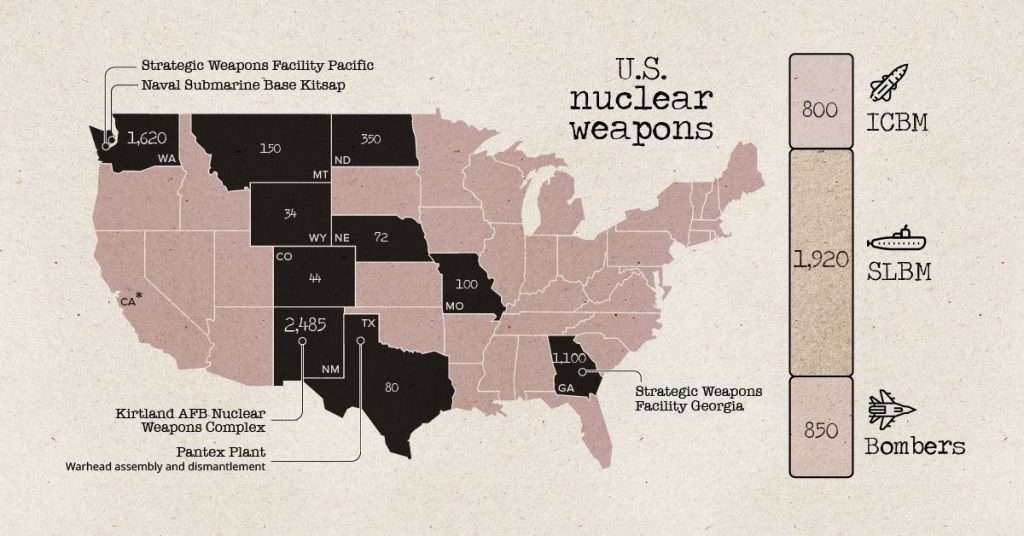



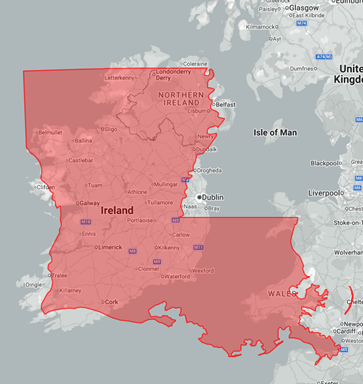
The average US state has 6.9M people. Louisiana has 4.7M, only 1.4% of US population. Yet Free Louisiana points out how strong even a small US state is compared to many foreign countries:
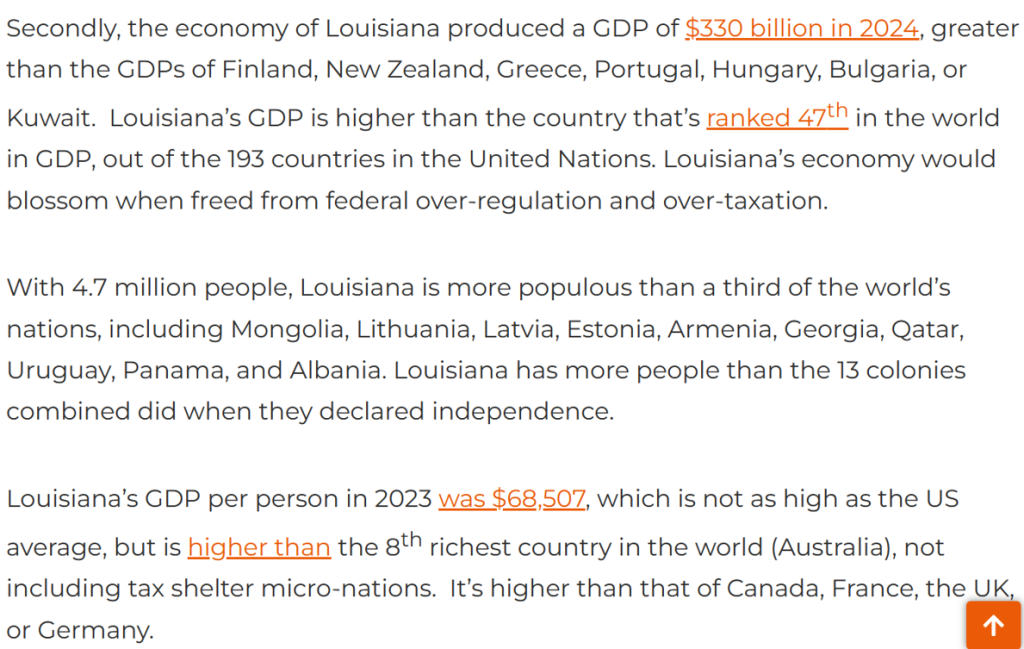
“If Louisiana spends the NATO standard of 5% of GDP on defense, her military spending will rank 24th – greater than that of 170 countries in the world. To deter attack, we only have to make an attack on Louisiana more costly to other countries than any benefits of the attack.” ~ Free Louisiana
We considered other aspects of the question of proper size for a country in an article on revolutionary secession from the US of a portion of a US state. There are 194 countries in the world, and many are small countries that persist because they comply with the demands of potential aggressors, and they make the cost of attack greater than the benefits of attack. As for deterring military attack during secession, see our articles here and here and here. As for deterring attack well after secession, see here.
We are currently researching an article about how much of the US economy a state or group of states needs in order to deter embargo and other economic pressure from the US during a unilateral state secession from the US. If your state isn’t as big as Texas or Florida, your state might want to hold off on implementing secession until it has a group of states committed to doing it together, whose combined GDP is several % of US GDP.
To avoid forgetting all about this wonderful website, subscribe to our free Substack to get a few articles per year in your inbox. Or our social media.
Thanks for researching this — a data-driven analysis of the minimum size for a country full of people like us. And ‘minimum’ may well be ‘best’.
Probably somebody could write a book, or a dissertation, on the topic. But a dissertation might be hard to do at an American university for political reasons.
Anyhow, the population of the 13 colonies was 3 million, and the population of Elizabethan England was similar (2.8 million in 1558 to over 4 million at the end of her reign in 1603). So, for our people, the 4 million count should certainly suffice.
wow, I didn’t know England was so smol then
One important thing to focus on is what a new constitution would need.
Buffer zone for non native migrants. No one not born in the new red America could live anywhere but the buffer zone.
Firewalled Internet. The red new America must not permit a shared global Internet. We live on the Internet and that space needs borders.
Immigration must be limited to majority Christian source states. And it must be limited to no more than 1/10000th of the citizen population per year max. And this must be an immutable part of the Constitution.
Corporations created globalization and a new red America must regulate its businesses. No acquisitions and no mergers. Otherwise businesses can become larger than the gov. And they are not democratically elected entities. No business may operate in more than one state or region. Allowing national media companies for example has enabled propaganda to brainwash our entire society.
Legislation expirations for policies outside the constitutuon. Legislation must have e.g. a 20 year expiration. Otherwise regulations endlessly accumulate.
Confederation-only. Central government is limited to enforcing the Constitution, foreign policy, and border policy. The central government cannot create new social policy.
Businesses must have the freedom to fire or refuse to hire anyone for any reason and no future policy may say otherwise.
Christianity most be the established religion and taught to children in schools.