“Freed from constant fight to death battles over who controls Washington, who is appointed to the Supreme Court, we could meet as neighbors, business partners, and even friends without seeing one another as existential threats”
Jordan Karp December 2025 https://www.westernjournal.com/op-ed-political-division-severe-america-split-two/
The US has been at peace with its neighbors Canada since 1814, Mexico since 1845, Cuba since 1898, and the British Empire at the Bahamas, Caribbean & Canada since 1814. But Americans have been at war with each other in 1865 and throughout the rise of Leftism: during industrialization, calling out the National Guard to break massive, violent labor strikes and deport anarchist bombers. In the 1960s, thousands of leftist bombings of mostly empty buildings, black nationalist violence, black riots. Political assassinations. And now the cold civil war over control of the GAE has become bitter, winner-takes-all, desperate, and will likely become lawless.
Again, Americans have been at peace with Canadians for 2 centuries, but not with Americans. Why? Because separate countries mind their own business as long as we can make any attack on the US costly, but Leftists with whom we share a federal government can’t afford to leave us alone, because we’re tying to impose our will on them.
Sharing a citizenship with them prevents us from physically retaliating when they use a government to oppress us. Sharing a government with them makes us vulnerable to predation. It gives them an opportunity to tax us and make us obey every law they pass without facing the risk of interstate (international) war.
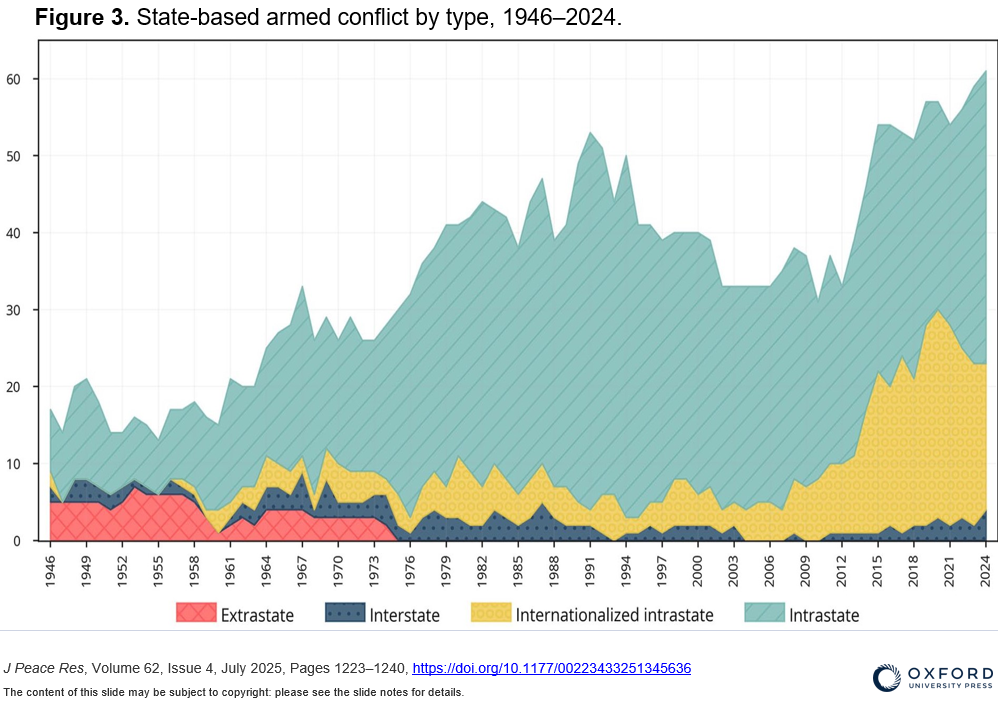
National Divorce (state secession) is safer than remaining a Union of 50 states because it probably prevents civil war, and once we’re 2 or more separate countries, we’re not likely to go to war with each other often. Since the end of World War II, civil wars (intrastate organized violence) are 31 times more common than interstate (international) wars (= 50 / 1536), according to our tabulation of the data from the chart above. That chart only considers wars that a state (a country’s government) is involved in. It doesn’t even include civil strife between two non-state groups within a country. Since WWII, battle-related deaths due to civil strife involving state governments were 6 times more numerous than due to interstate wars (= 333k / 1898k). This doesn’t include non-battle deaths such as executions, starvation, etc, which are more prominent in intrastate oppression, riots and black-on-Caucasian crime, not interstate wars..
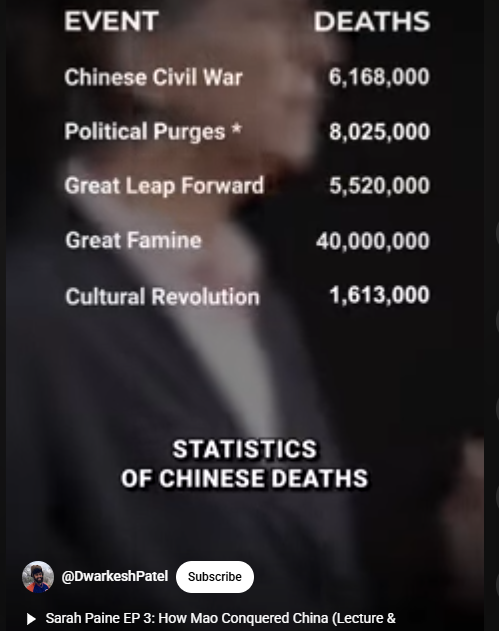
Although it occurred before this period, consider the difference between the death toll of Japan’s state invasion of China, as compared to the civil strife within China later:
This is partly because the US, African governments, and others have tried to punish interstate invasion more than they punish civil war. But it’s mostly because conflict between states his handled by professional diplomats, military generals, and presidents whose decision on a ceasefire, full-scale retaliation, or anywhere in between will be respected by their state. Unlike states, ethnicities, ideological enemies, and other mobs within a state don’t take orders from a hierarchy and don’t usually observe ceasefires, so it’s difficult to negotiate on their behalf to get concessions from their opponents. If a crowd doesn’t obey the negotiator, then the crowd has little leverage over anyone. We considered this at length in another article.
Some would argue that US state secession can cause civil war within states or counties as they argue about which federation to be a part of. About a third of US-born Americans live in a state they weren’t born in, so Americans are more willing to move across state lines than foreigners were willing to move to another country (with another language). So it’s easier for a conservative to move from a blue or purple state to a red state than to walk out the door and find someone to shoot or be shot to somehow make his county a part of a red state, and vice versa.
Looking at the image above, note that in the US, National Divorce is a way to avoid civil war and political purges between Right & Left. But it’s also a way red states can avoid future US socialist failures such as the Great Leap Forward, the Great Famine, and the Cultural Revolution. Red states can avoid not only deaths, but also poverty, injustice, government-forced sin, racial & gender hatred, etc.
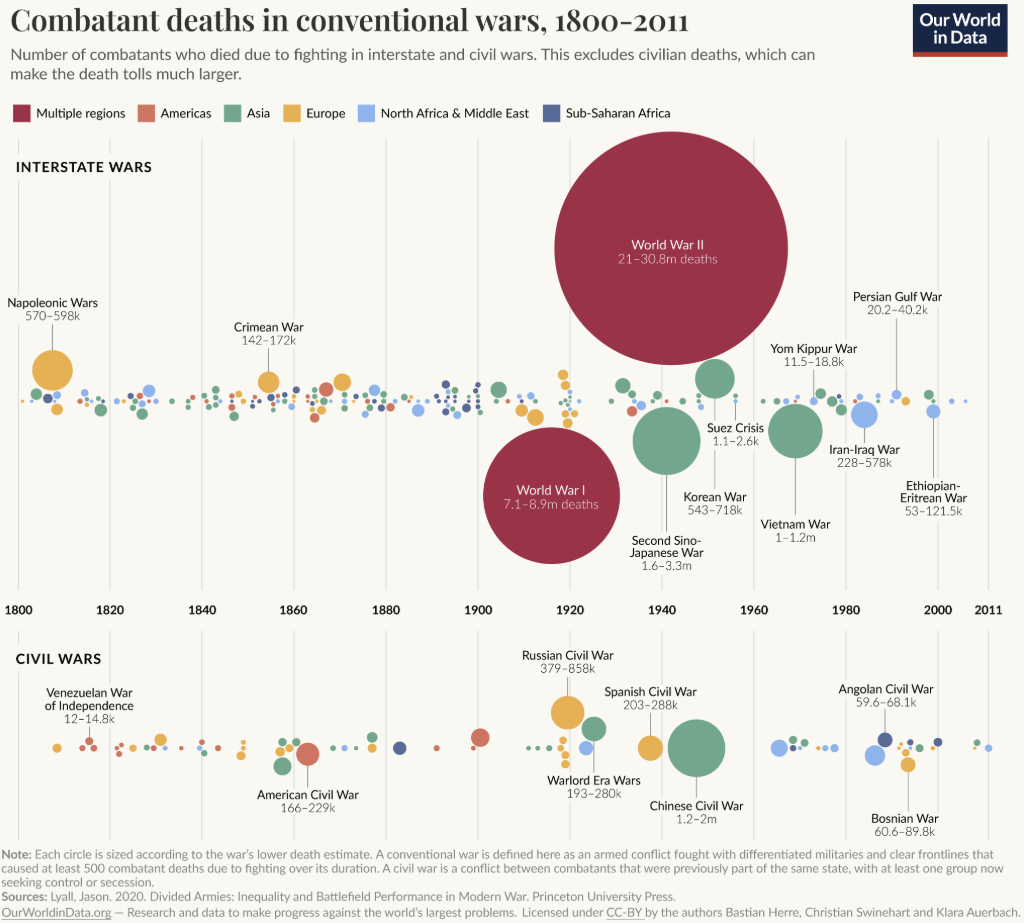
Now we’ll admit that looking at the chart below that goes back to 1800, deaths due to interstate wars dwarf major civil wars, but this chart does not include other types of civil strife mentioned above. It only includes “a conflict between combatants that were previously part of the same state, with at least one group seeking control or secession.”
We aren’t arguing that, if secession doesn’t happen, the American right-wing will organize a revolution against the US federal government. We’re arguing that the the federal government will cause many casualties to disfavored groups within the US, as happened in China and Bolshevik Russia, if secession doesn’t occur. These casualties would be caused by racial malice, political malice, and by economic collapse caused by incompetence, Leftist envy of billionaires & boomers & entrepreneurs & AI, taxation, regulation, and socialist confiscation. We’re confident that the federal government will gradually move Left, because of the incentives Curtis Yarvin explains, and because the Left is much more powerful & influential than the Right in the US. And the American right wing has committed so few vigilante attacks, or any attacks, against the Left that they’re (we’re) obviously not the type of Americans to organize and start a violent revolution. Not even after the assassination of Charlie Kirk. We believe that the regime will be wise enough to change policies gradually as it consolidates control, in order to avoid losing control or sparking a right-wing revolution, as every other country in Europe & the Anglosphere has done.
Some readers will be confused. Shouldn’t secessionists want to assure everyone that civil wars aren’t too bad, since unilateral secession can cause a civil war? We’ve argued that a president is unlikely to find ordering an attack wise or practical. The fear should be the cost of remaining a part of an increasingly socialist US, not the risk of strife during a secession or afterwards between the future parts of the US.
To avoid forgetting all about this wonderful website, subscribe to our free Substack to get a few articles per year in your inbox. Or our social media.